Families are the compass that guide us. They are the inspiration to reach great heights, and our comfort when we occasionally falter. -- Brad Henry

Monday, June 13, 2022

Israel - 1

After we crossed the Jordanian/Israeli border, we drove to our hotel in Tel-Aviv. It was just a few blocks away from the Mediterranean Sea and we wanted to check it out. Ashlyn wanted to skip the next day and join the beach volleyball games down below, but our schedule was too busy for a rest day.

Our first sightseeing day in Israel began in Joppa (aka Jaffa), one of the oldest port cities in the world. Just a half mile away from Tel-Aviv, the two cities joined as they grew and it's now known as Tel-Aviv-Jaffa. In Joppa, several major events happened that you can find in the Bible. In the Old Testament, this is where Jonas fled, went out to sea on a boat, and was swallowed by a whale. (Jonah 1:3) Then in the New Testament, Peter raised Tabitha from the dead. (Acts 9:36). While in Joppa, Peter stayed in the home of a tanner named Simon (Acts 9:43). That home is under the church you can see on the right of this picture (it's a rocky square structure 2 buildings behind the white truck).

After Joppa, we drove north up the Mediterranean coastline to a town called Caesarea Maritime. There were several towns in Israel names after Caesar, so it's important to keep "Maritime" after it. This was aptly named because of the coast.

Here, King Herod had his main royal palace. His ruins are still being excavated, but you can see below the theater. 

A closer look from the side entrance (lower levels) where VIPs back in the day would enter.

This theater is still used today by locals, alhtough they had to reinforce rows 3 and above. The lowest rows 1 & 2 are still original (where Luke is sitting).

King Herod also had an outdoor arena for competitions. His palace was the center piece of the town where people of high social class wanted to be seen.

During their excavations, they found this stone which provided archelolgical proof that Pontius Pilate lived during this time and had a leadership role within Roman authority. 

These are the ruins of his personal residence. In the far distance is a large, olympic-size fresh water pool. The pool was fed from an aqueduct built to transport water from Mount Carmel. In the foreground you can see that the flooring used to be beautiful mosaics. There's another courtyard to the right (not in the picture) where St. Paul defended himself before his final journey to Rome to appeal his case to Caesar (Acts 25). 

We then left the coastline and drove inland up to Mount Carmel. At the highest point in Mount Carmel, Elijah defeated the false prophet ba'al. From this vantage point, you can see the Jezerel Valley which has the most fertile land in Israel. 

The Jezerel Valley was the main trade route from Egypt to Babylon in 4000BC. This valley was protected and controlled by a small village called Megiddo that was built on top of a hill. As we walked up the hill, the kids decided to have some fun.

Those ruins are still intact, and it was incredible to see how they lived and obtained fresh water for their community.


The walls separated the common areas from the housing units.

This valley near Mediggo is prophesied to be the site of Armageddon, or where the gathering of armies for the end of times will take place. 

We then drove up north out of the valley and into the region of Galilee to the town of Nazareth. Nazareth was a very poor town on a mountain top that got very cold in the winter. About 40-50 families lived here in Jesus' time, and they lived underground in caves to stay warm. Below is a view from inside the Church of the Annunciation. It's where Mary lived as a girl (Luke 1:26), where the Angel Gabriel appeared to Mary, and where Jesus was raised for 27 years after they returned from Egypt. You can see three different churches build over the cave, as each time one structure was destroyed, another would be built over it. It's been excavated back to the original structure (or what's left of it).


A closer view of the cave. You can see the stairs coming down that the Holy Family must have walked thousands of times.

Still in Nazareth, but at the edge of the town, there's a cliff where Jesus was attempted to be thrown down but walked back through the crowd (Luke 4:29). “Truly I tell you, no prophet is accepted in his hometown." Below is that cliff called Mount Precipice.

Sunday, June 12, 2022

Jordan - 2

We continued our journey through Jordan and made a stop where Moses is said to have performed a miracle with his staff: 

Numbers 20:11 "Then Moses raised his arm and struck the rock twice with his staff. Water gushed out, and the community and their livestock drank."


This natural spring is still running today. While here, we saw locals bringing empty jugs to fill their containers with this water.


Since it was a Sunday, and most of our group were Catholics, we asked our guide if he knew of a nearby church offering Mass. The guide surprised us by saying he's Catholic himself and lives in that town, so he took us to his own church. 

When our guide introduced us to the priest, he invited us to do the 2nd reading and also sing the communion hymn. Our group volunteered Eric, so here's a special moment of the Arabic service taking a brief pause and allowing the reading to be in English.


Under the church were Byzantine ruins, so the priest allowed us to tour without the normal entrance fees.


The unexpected stop on our itinerary turned into a great excursion!


We then travelled to Mount Nebo, the place where Moses showed the Israelites the Promised Land. But because Moses struck the rock twice and did not follow the Lord's instructions, he was not allowed to enter. If we continue in the Bible verse from above, it reads:

Numbers 20:12  But the LORD said to Moses and Aaron, “Because you did not trust in me enough to honor me as holy in the sight of the Israelites, you will not bring this community into the land I give them.”


Here we get to view the Promised Land as Moses and the Israelites did.


From here we can see the Jordan River, Jericho, Jerusalem, Bethlehem, and the Dead Sea. 


Mount Nebo also had some olive trees. The guide gave us a quick lesson on how long a new plant takes to bear fruit, when they harvest, the purpose for each press (squeeze), and how long they live. These are really hearty to grow in this area. I can see why so many people depended on them and the date trees for survival.


Our final stop in the country took us to the Jordan River. It wasn't as wide as I expected. I tried to imagine John the Baptist living here in the scorching hot weather eating locusts and wild honey (date syrup) while keeping a keen eye out for snakes and other wildlife.


The river has veered off course in 2,000 years since Jesus' time, but the exact spot where he was baptized has been identified by both Jordan and Israel as this place below. There's no water running through it now.


We took the opportunity to see the River Jordan with our own eyes and watch people on the other side (Israel) get baptized.


The Jordanian side of the river was much less developed, but there was a small area to immerse yourself (or a hand). Pretty incredible.

Saturday, June 11, 2022

Jordan - 1

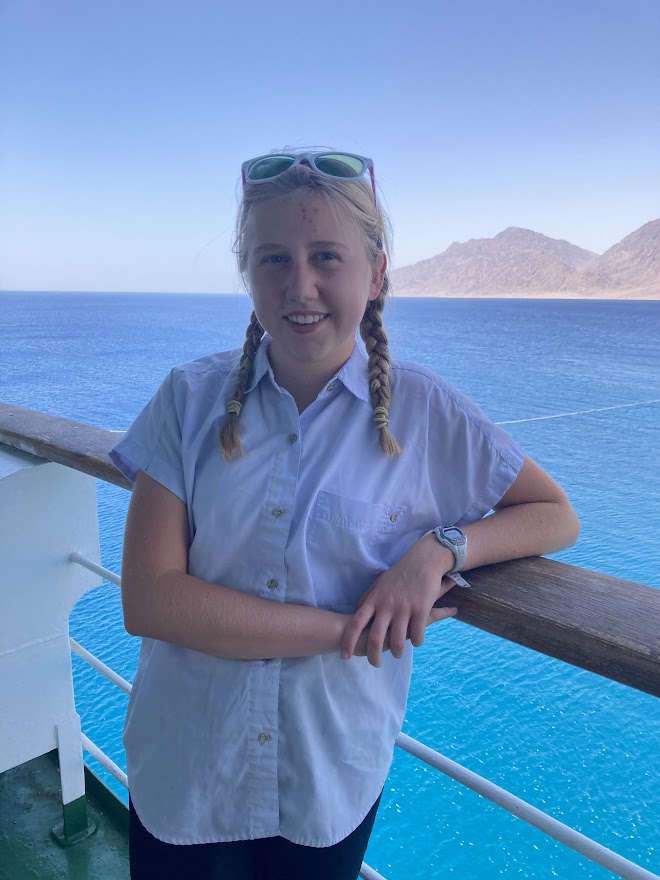
Our early morning bus ride from Mount Sinai to the Red Sea gave us much needed rest from our midnight hike. Once at the sea port, we boarded a ferry that would take us into Jordan. 

The water was so clear! That surprised me, and I read that there were great diving spots in the Red Sea similar to the Caribbean. 

Something to note is that everywhere we went in the Arab countries, we were treated like VIPs. They depend on tourism for their survival, and their hospitality is superb! We did have an armed police officer with us at all times for good measure, though. This allowed us speedier check points and ensured our safety from potential theives or pickpockets. 

But once on the ferry, we discovered that it was boarded by 98% men who traveled from Egypt looking for work in Jordan. As the men's restroom had a waiting line, they began using the women's. At one point, I counted 8 men in the women's restroom! Needless to say, the girls in our tour held our bladders until we arrived at our destination. And one more point about the toilets...they don't use toilet paper. Instead, they use a water wand or bidet faucet. It takes some getting used to. I ended up spraying way more than intended, and decided to start bringing my own tissue into the stalls.

Upon our arrival into Jordan, I noticed a little more wealth. There's still poverty in the country, but they have less population overall and seem to have better infrastructure. Much of the land is still desert and barren, though.

After a delicious meal and good night's sleep, we started the next day by walking from the hotel to Petra. The dirt/cobblestone road into this ancient city is called the Siq. If you've ever watched Indiana Jones and the Last Crusade (3rd in the series), Harrison Ford rides a horse into this settlement. It's one of the Seven Wonders of the World along with the Giza Pyramids.


While most of the Siq is a natural rock formation, some parts were sculptured by the Nabataeans. The Siq was kept narrow to better defend their territory from invading armies. Some of the native decendents still live here today and sell trinkets.


About half a mile into the canyon, we caught a glimpse of one of their most famous sites...the Treasury. It is literally a jewel that's hidden until you're almost right in front of it.


It took my breath away to see this in person! 


Although we couldn't go into the Treasury, there were so many places we could explore.


And there were camels everywhere.


When we found a few places we're allowed to go inside, they were basically just dark rectangular rooms that smelled like animal urine. Back in their prime, these places were used by families and for burial of loved ones. 


This one was not accesible to tourists, but super cool to photograph.


With the limited time available to explore, our family voted to hike up to the sacrifical temple.


A reinactment, courtesy of my kids.


The views from the top were amazing!


As we headed back down, we found a bunch of other houses carved into the cliffs.


Each of us selected our own "house". 


One final family pic in Petra before we head back.


Now for the long walk back up the Siq.

Thursday, June 9, 2022

Egypt - 2

As we continued on our journey through Egypt, I couldn't help but notice the poverty. Years ago, the Egyptian government decided not to tax their citizens and only use revenue from tourism to build infrastructure. This prevented the country from having support systems and proper education for their large population. Cairo is the sixth largest city in the world with 25 million people.

Today, their government is taxing their citizens and using the much needed revenue to improve their roads, schools, and infrastructure, to tear down dilapidated buildings, and impose strict building regulations to ensure safe housing. It will take time, but at least it's in the right direction.


Our path East took us under the Suez Canal through a tunnel and out into the Sinai Peninsula.


I took these pictures to show the harsh environment that Moses and the Israelites walked in for 40 years as they escaped slavery in Egypt.


In Exodus 15:27, the Bible states that "they came to Elim, where there were twelve springs and seventy palm trees, and they camped there." Here's the place where it's identified as Elim. There are 12 springs and a natural orchard of palm (date) trees. 


Exodus 16:1 On the fifteenth day of the second month after they had left the land of Egypt, the whole congregation of Israel set out from Elim and came to the Desert of Sin, which is between Elim and Sinai. 

As we approached Mount Sinai, there's a rocky area that, if you look close in the middle of the picture, bears resemblance of a calf. This is said to be the inspiration for the golden calf which was a false idol created by the Israelites from melted gold.


At the base of Mount Sinai is the Monastery of St. Catherine, one of the oldest monasteries in the world. A quick biography here...Catherine was born in Alexandria, Egypt in 305AD. In her early teens, she converted to Christianity and chose not to marry despite her many suiters. This angered the emporer who also wanted to marry her, so he sent many scholars and philosophers to debate her. Instead, she converted them to Christianity. He then commanded her to be executed on a wheel. (This is important later in my post from Israel.)

When Catherine touched the wheel, it shattered. Unable to execute her through torture, she was then beheaded. Later in a dream, some monks were told that St. Catherine's body was carried by angels to the top of Mount Sinai. When they awoke, they climbed the mountain and found her body just as it was fortold. Thus, the monastery was built at the base in her memory in the 6th century.

Here's the road to St. Catherine's Monastery and Mount Sinai.


St. Catherine's Monastery.


Our visit was timed perfectly, as the service was just finishing up. Our small group was allowed inside to look around.


The monastery houses a well called the "Well of Moses" where Moses is said to have met his future wife, Zipporah. 


The burning bush is also here. The bush was originally a few yards away in the mountainside, but transplanted here to give it a protected stone wall and is cared for by the monks. The bush (or one of it's shoots), is still alive today.


Also here is a unique stone that is found no where else but on Mount Sinai. If you break open these rocks, you'll find markings that resemble the burning bush.


The monastery is home to several ancient manuscripts. 


Back outside, I found Luke in his sheek scarf eyeing Mount Sinai.


We decided to come back at midnight to start the climb!


The climb to the top was no joke. After 2/3 the way up a not-so-gentle slope, you start the steepest part containing 750 steps. And, they don't have hiking poles like we have in the US. Instead, they use walking canes which actually came in handy on the way down to soften my knees. The kids were making fun of me, though. The local Bedouin guide taught them to say Yalla Yalla, or hurry up old woman. It was funny.


We arrived on the top at 3:30am. Our guide kept trying to motivate us by saying there's Starbucks at the top. None of us wanted coffee, but we decided to purchase a cup anyway to support the Bedouins who live on the mountain and rely on on tourists as their source of income. It was pretty gross, with lots of sediment at the bottom.


One of the very cool things at the top was a cave where Moses camped as God spoke to him. The Muslims have a strong reverence for Moses, so this was holy ground for all of us.


Sunrise was not for another hour, we posed for a few more pictures and enjoyed the starry night sky with a very bright Milky Way.


To ensure we were back at the hotel by 7am, we headed down the mountain a little before sunrise. Then just as the horizen began to brighten, we stopped for photos.